
Project Field Note: Retrofitting a 15,000㎡ Industrial Machining Facility with LED UFO High Bay Lights
How a 15,000㎡ precision machining plant replaced 400W metal halide fixtures with 150W LED UFO high bays — cutting lighting energy by 63% and reaching full payback in 13 months.
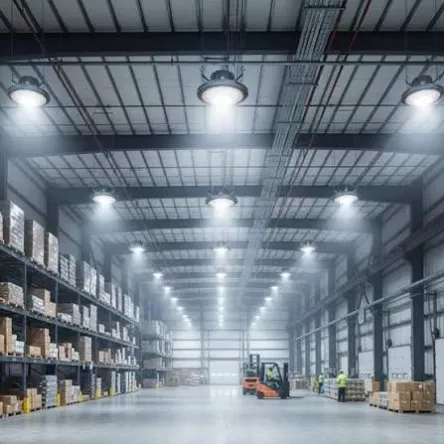
For plant managers and industrial contractors, aging illumination systems are a silent drain on facility operational budgets. Older metal halide (MH) and high-pressure sodium (HPS) fixtures are notorious for slow warm-up times, high energy consumption, frequent ballast failures, and steep lumen depreciation.
Recently, our engineering team partnered with an industrial manufacturing facility in southern China to execute a comprehensive lighting retrofit across their 15,000-square-meter precision machining and assembly plant.
Here is an inside look at the challenges faced, the technical solution implemented, and the measurable transformation achieved.
1. The Challenge: Outdated Lighting in a High-Ceiling Workshop
Before the upgrade, the 12-meter-high facility relied on legacy 400W metal halide fixtures that had been in operation for over seven years. The plant management highlighted three major pain points:
- Soaring Electricity Costs: Operating 16 hours a day across two shifts, the old fixtures drew excessive wattage while delivering poor luminous efficacy (~75–80 lm/W).
- High Maintenance Overhead: Due to the extreme ceiling height and frequent lamp burnouts, maintenance staff had to rent scissor lifts and halt nearby assembly lines to replace bulbs and ballasts.
- Severe Glare and Shadows: Uneven light distribution and flickering tubes created safety hazards around heavy milling machines and high-speed forklift traffic routes.
2. The Solution: High-Efficacy LED UFO High Bay Lights
Following a detailed Dialux lighting simulation, our team replaced the legacy metal halide units with 150W LED UFO High Bay Lights engineered with an impressive 160 lm/W luminous efficacy.
- Massive Energy Reduction: Swapping 400W metal halide fixtures for 150W LED UFOs cut immediate energy consumption by over 60% while significantly boosting overall brightness.
- Robust Thermal Management: The fixtures feature heavy-duty, die-cast aluminum housings with finned heat sinks, ensuring optimal thermal dissipation in a demanding workshop environment.
- IP65 Protection & Precision Optics: Protected against fine metallic dust and occasional moisture, the fixtures utilized 90-degree optical lenses to focus light downward onto the work planes, achieving a uniform average illuminance of 500 lux at floor level.
3. Project Execution Steps
Retrofitting an active manufacturing facility requires strict schedule coordination to ensure production lines are not interrupted.
- Site Assessment & Dialux Simulation: Phase 1 - Week 1.
Conducted on-site lux level audits, evaluated existing electrical load capacities, and mapped precise fixture positioning to eliminate dark zones.
- Zonal Installation Planning: Phase 2 - Week 2.
Divided the 15,000㎡ plant into four distinct manufacturing zones. Coordinated with plant supervisors to schedule installations during weekend shifts.
- Dismantling & Wiring Prep: Phase 3 - Week 3.
Removed legacy metal halide fixtures, inspected structural hanging hooks, and prepared secure quick-connect wiring terminals.
- Mounting & Commissioning: Phase 4 - Week 4.
Suspended the new LED UFO high bays using secure safety chains, tested circuit loads, and performed final lighting validation audits.
4. Results and Return on Investment (ROI)
The transformation was immediate. Operators and machinists praised the crisp, daylight-like illumination (5000K CCT), which significantly reduced eye strain during fine calibration work.
Financially and operationally, the upgrade delivered exceptional performance:
- Energy Consumption: Reduced monthly lighting electricity overhead by 63%.
- Maintenance Expenses: Zero expected bulb or driver replacements over the next 50,000+ operating hours.
- Payback Period: Through utility savings and reduced maintenance labor, the total project investment achieved full ROI in just 13 months.